Ivory CoastTravel Guide
Request a quote
DE · EN · FR
Culture · Traditional Clothing

Traditional Clothing and Fabrics of Ivory Coast.

Five fabrics, three techniques, and one mistake almost every visitor makes. Korhogo cloth is not woven — it is painted. Pagne baoulé is made in narrow strips that are then sewn together. Wax arrives printed from a factory. This page sets out what is what, how each is made, how to tell handwork from mill cloth, and where to buy without paying tourist prices.
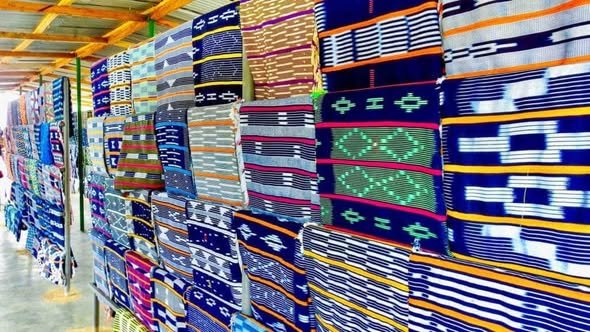
Stacks of handwoven pagne cloths on a market stall in Ivory Coast Handwoven pagne cloths at the market
{{ f.k }}
{{ f.v }}
Woven, painted, printed — three different things
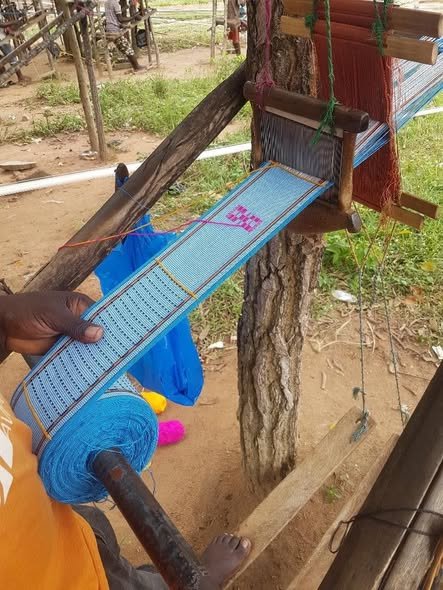
Three processes that are easily confused. Woven means the pattern is in the weave itself, because the yarn was dyed before weaving — pagne baoulé and kita are made this way, in narrow strips on a hand loom. Painted means a finished handwoven cloth is then painted with earth pigments — this is the case for Korhogo cloth and for bogolan. Printed means the cloth comes machine-printed from a mill, as with wax. All three are part of everyday Ivorian life, but they cost very different amounts and they do not mean the same thing.

The five fabrics worth knowing

{{ s.n }}
{{ s.t }}
{{ s.b }}
Weber an einem Schmalwebstuhl, ein blaues Baumwollband entsteht
Narrow loom — how a pagne is made
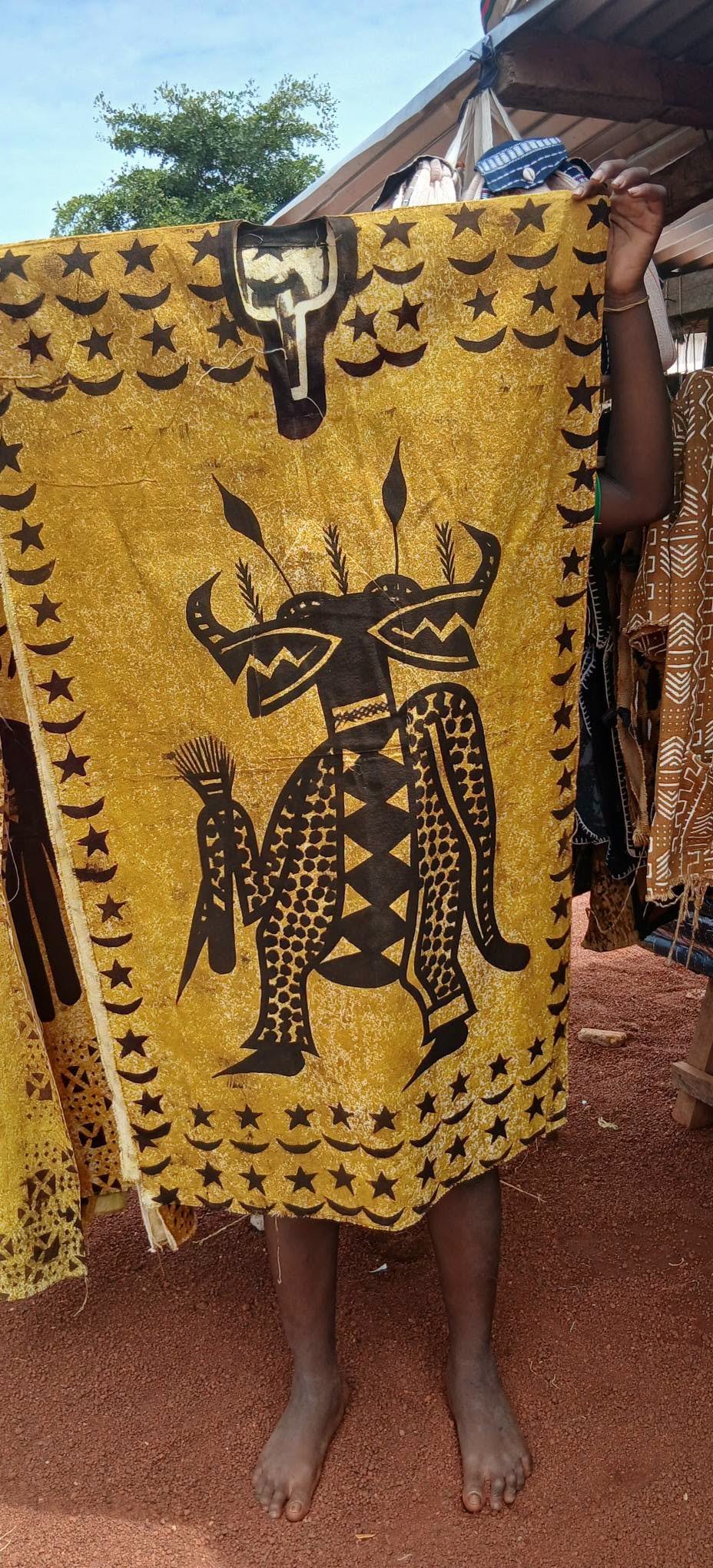
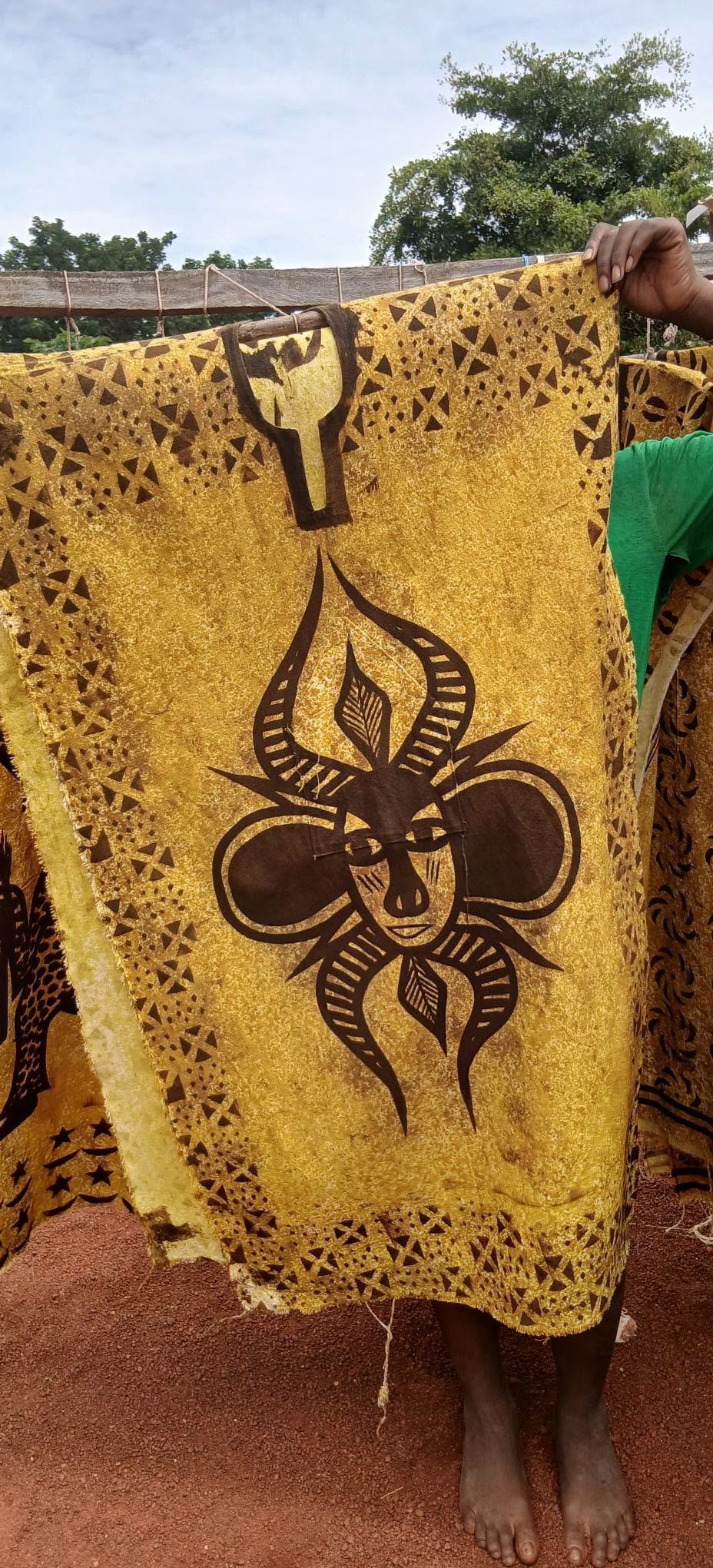
Yellow Korhogo tunic with a painted mask motif and star border
Korhogo cloth — hand-painted with earth pigments
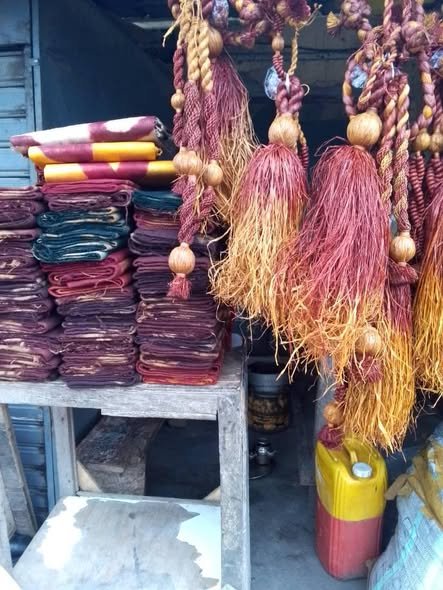
A dyer’s stall with dyed skeins of yarn and stacked cloths
Dyeing yarn before weaving
{{ c.kicker }}

{{ c.title }}

{{ p }}

{{ cd.t }}
{{ cd.b }}
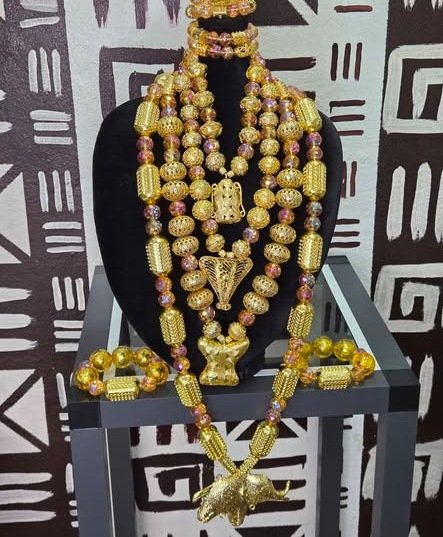
Multi-strand gold jewellery with beads and pendants on a display stand
Gold jewellery for ceremonies
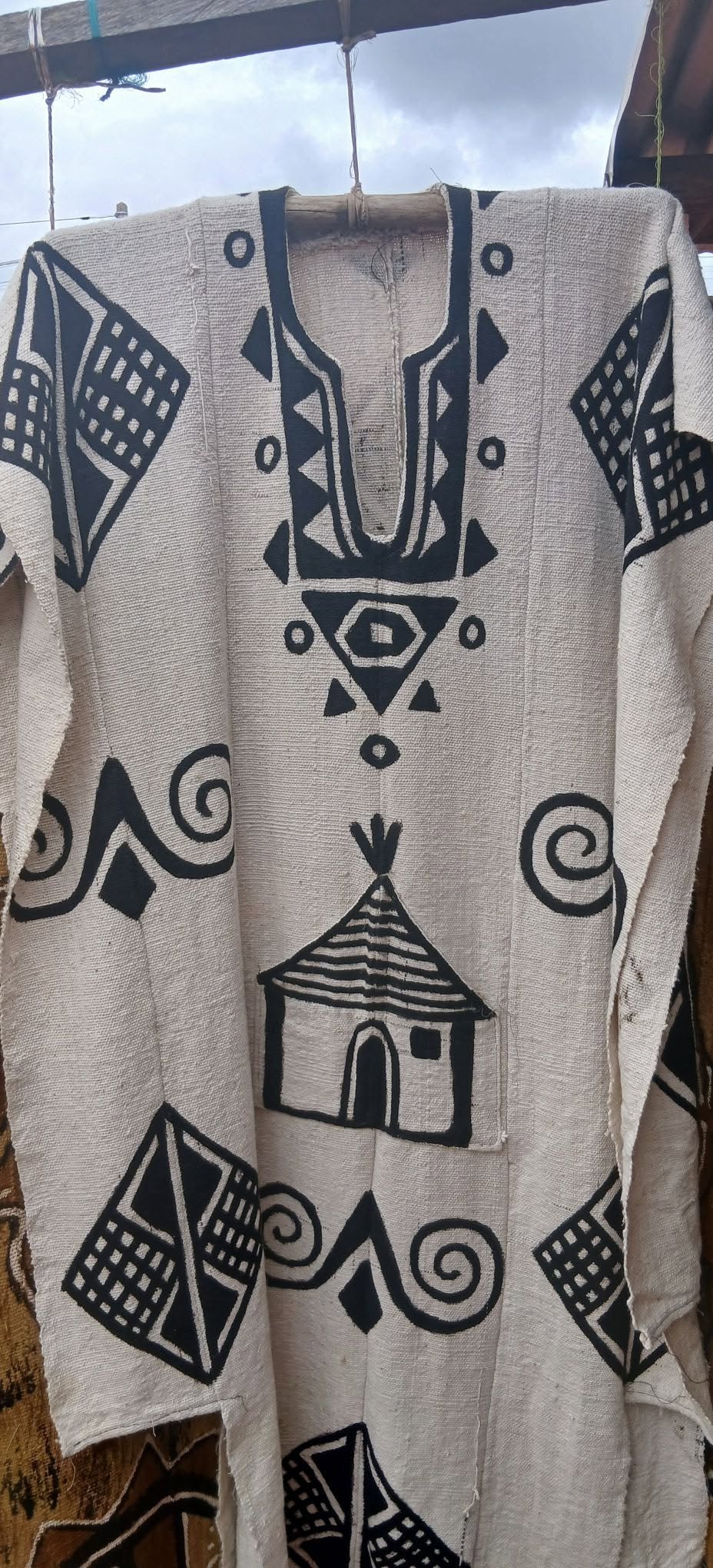
White bogolan tunic with black geometric signs painted on
Bogolan — signs on handwoven cotton
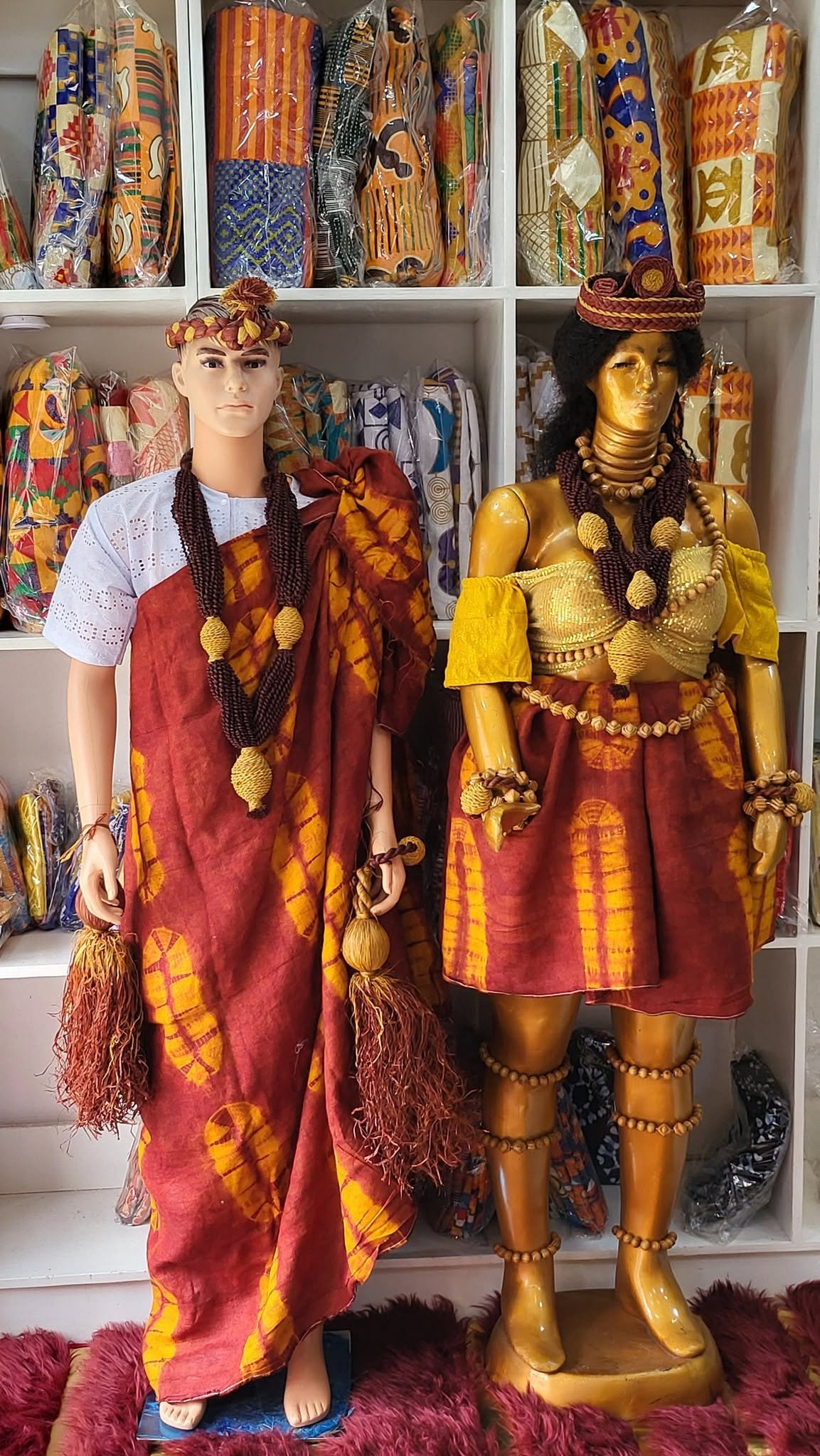
Two display figures in red and yellow batik ceremonial dress
Ceremonial dress in batik
Catalogue

Fabrics and models, listed by reference

Every model carries a fixed reference that stays the same in all language versions of this page. It exists so we can understand each other: when you write to us, the reference alone tells us which piece you mean. This is a catalogue for reference, not a shop — there are no prices here, no basket and no ordering.
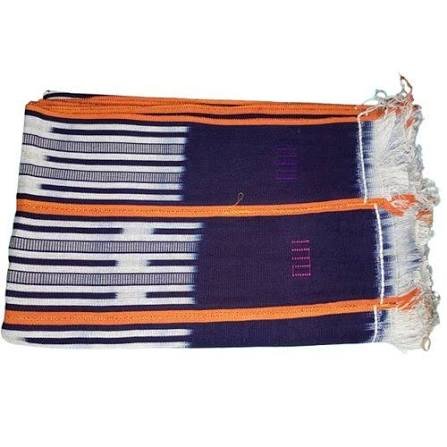
Handwoven pagne baoulé with blue and white striped bands
PB001 Pagne baoulé
Pagne baoulé, blue and white stripes
Narrow woven strips joined into a single cloth. The seams are visible on the reverse.
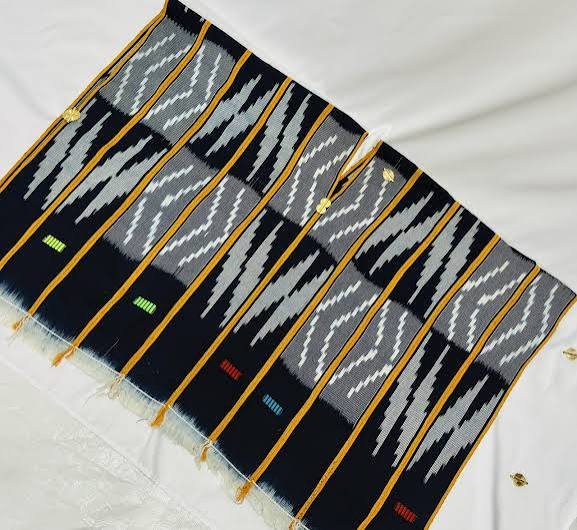
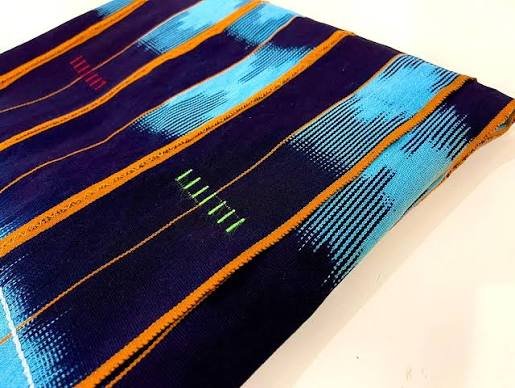
Pagne baoulé in indigo with pale ikat patterning
PB002 Pagne baoulé
Pagne baoulé, indigo with ikat
The pale flecks appear because the yarn is tied off in places and dyed before weaving.
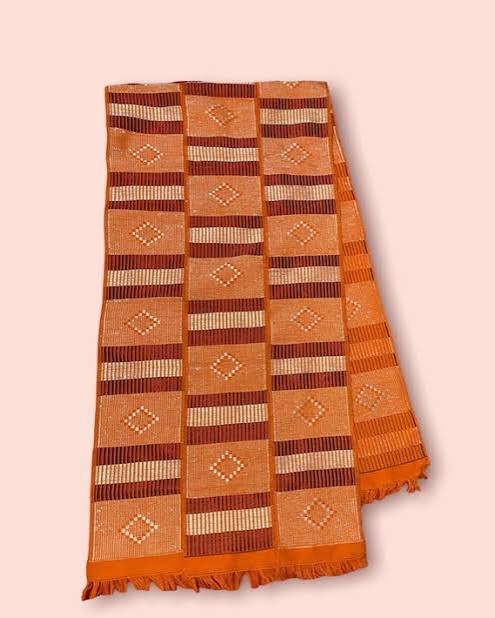
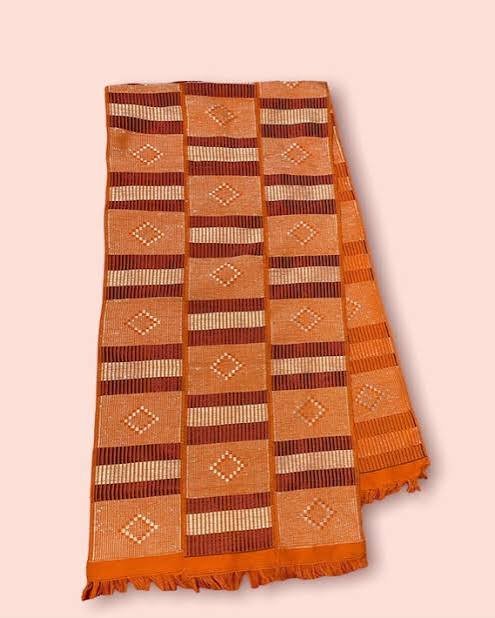
Pagne baoulé with orange diamond patterns on a pale ground
PB003 Pagne baoulé
Pagne baoulé, orange diamonds
A run of diamonds across the whole length. Strong colour, typical of festive dress.
Pagne baoulé with a blue and white zigzag pattern
PB004 Pagne baoulé
Pagne baoulé, zigzag
The pattern runs across the woven strips — harder to weave than plain stripes.
Pagne baoulé in yellow and wine red with ikat panels
PB005 Pagne baoulé
Pagne baoulé, yellow and wine red
Two colours in a clear sequence of blocks. Often worn as a wrap.
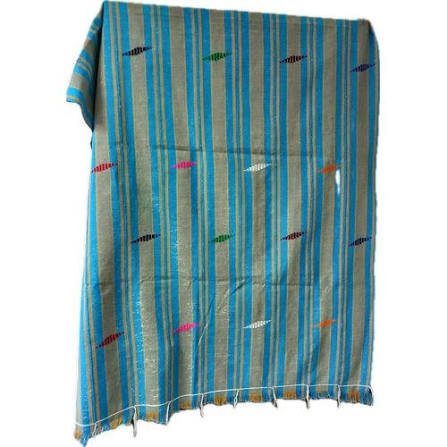
Pagne baoulé with turquoise and dark blue stripes
PB006 Pagne baoulé
Pagne baoulé, turquoise stripes
Fine striping, held up in the shop. A lighter weave for everyday wear.
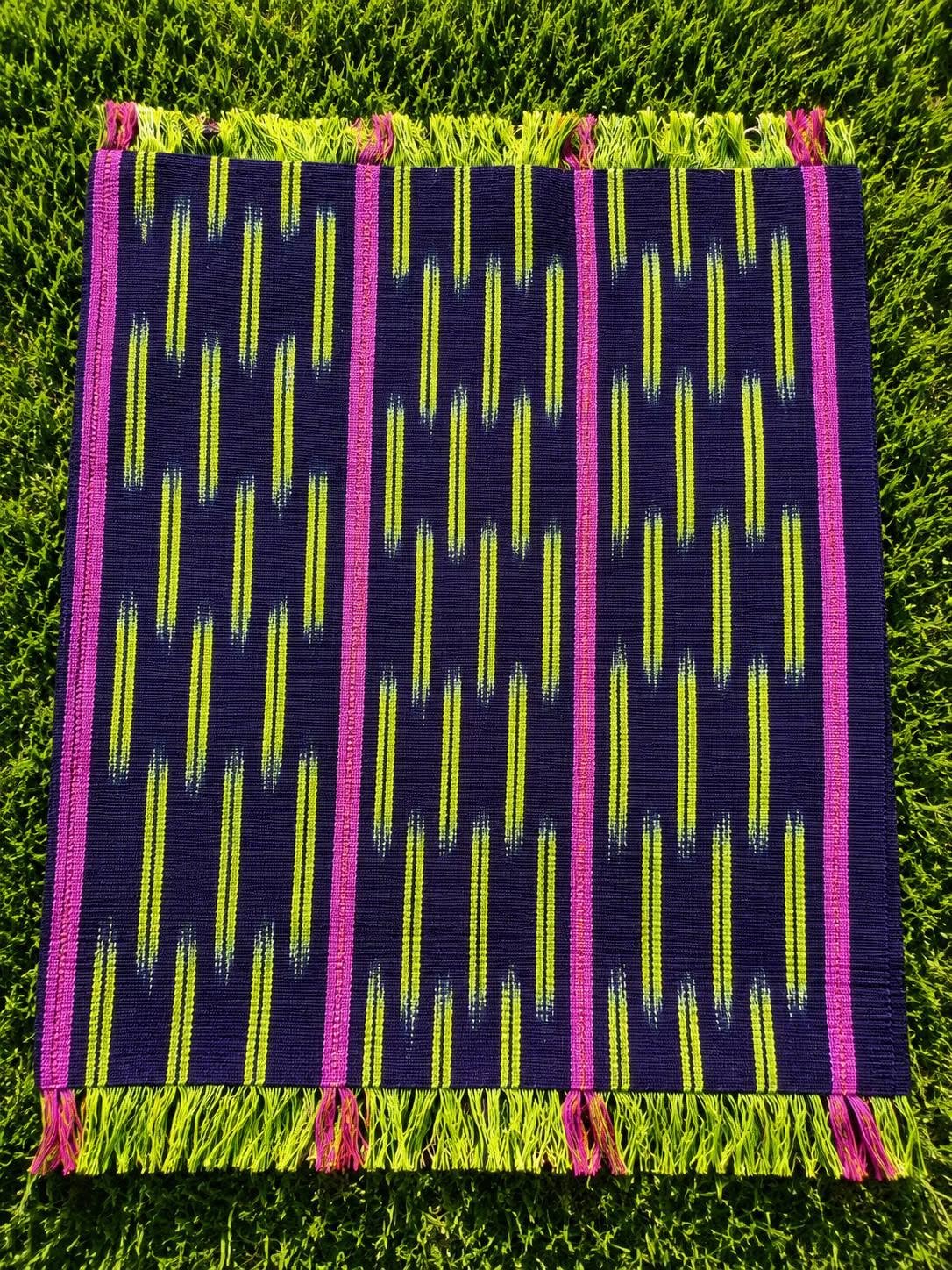
Pagne baoulé laid flat in dark blue with green fringes
PB007 Pagne baoulé
Pagne baoulé with fringes
Laid out in full, with fringes at both ends — this is the format of a complete length.
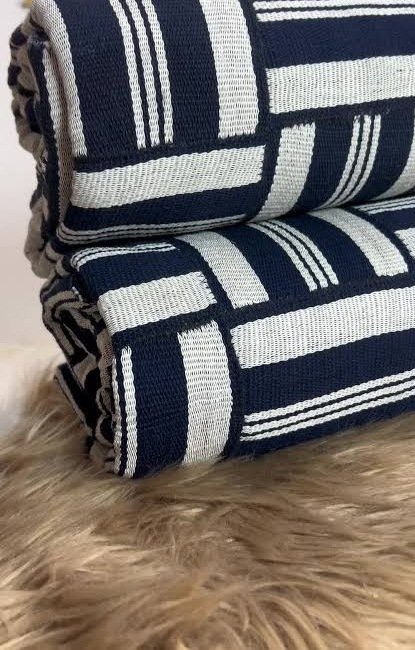
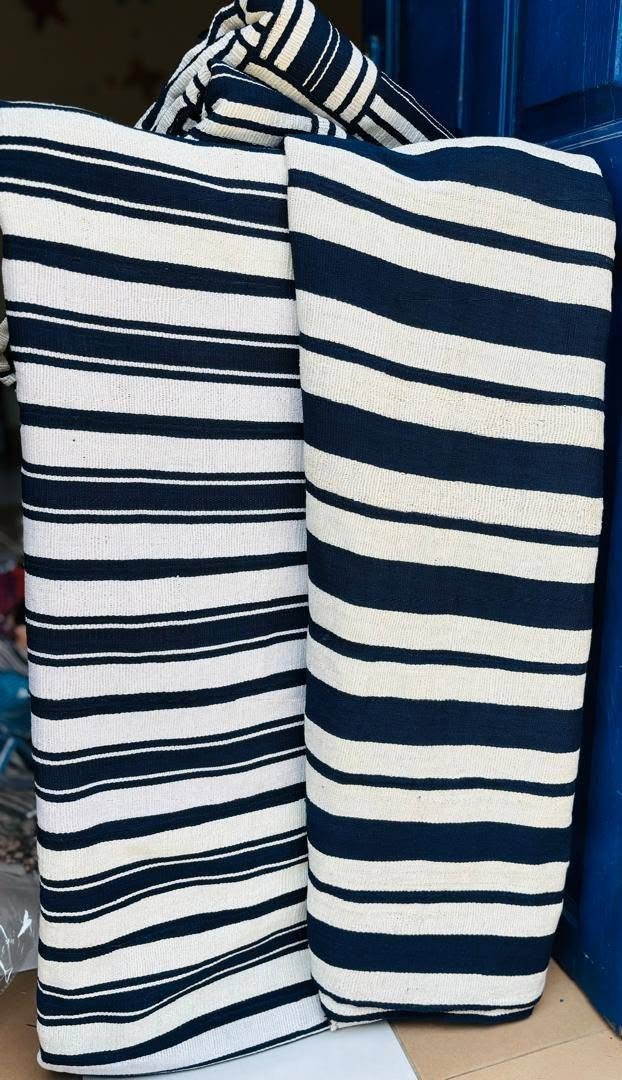
Folded pagne yacouba with navy and white lengthwise stripes
PY001 Pagne yacouba
Pagne yacouba, folded
Lengthwise stripes in navy and white — the mark of this weave.
Two lengths of pagne yacouba with stripes of differing width
PY002 Pagne yacouba
Pagne yacouba, two lengths
Two widths of striping side by side. Handwoven, undyed cotton with indigo.
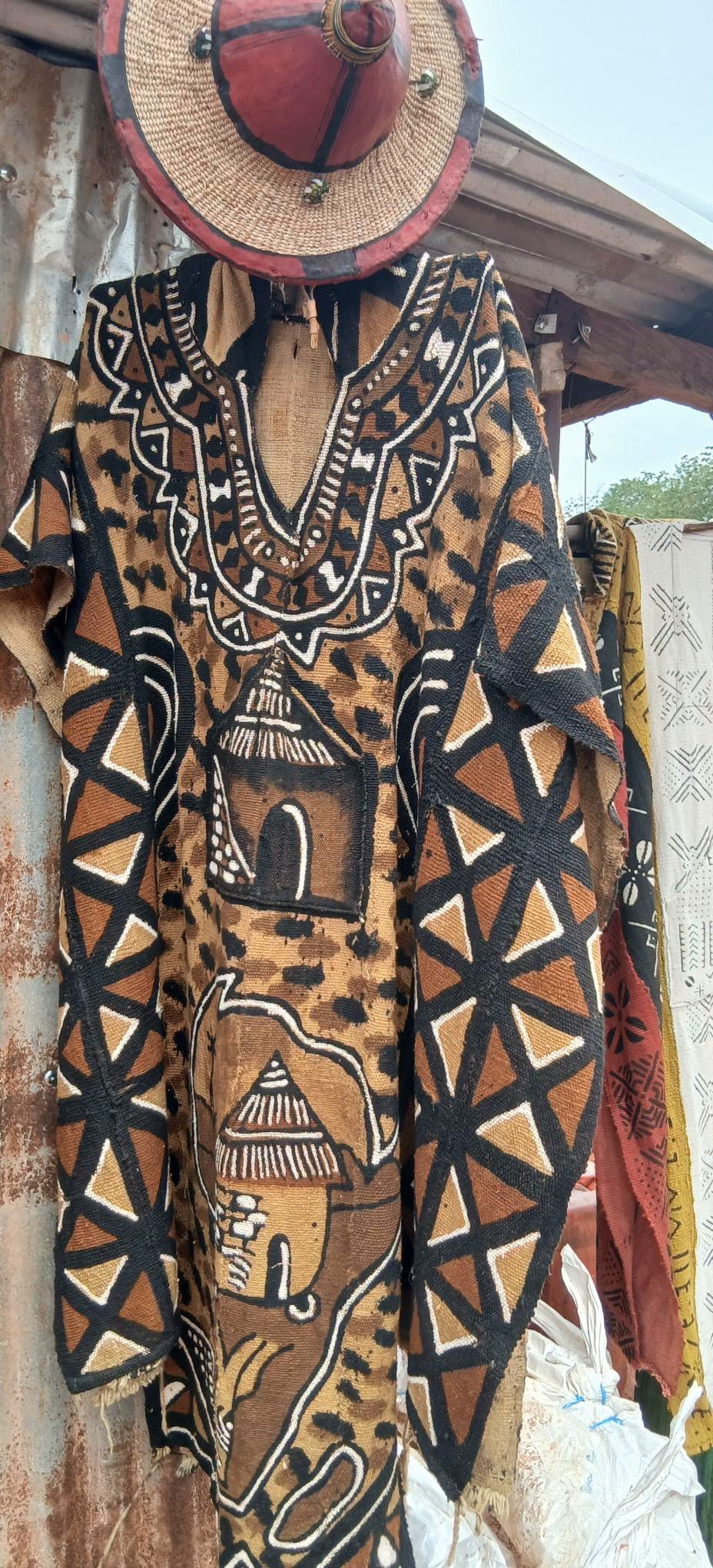
Korhogo tunic in brown and ochre with painted figures and a triangle border
TS001 Tenue senoufo
Korhogo cloth in earth tones
Brown, ochre and black on handwoven cotton. Figures and triangle border painted by hand.
Yellow Korhogo tunic with a painted antelope
TS002 Tenue senoufo
Korhogo cloth with antelope
The antelope belongs to the region’s established repertoire of motifs. Earth pigments on cotton.
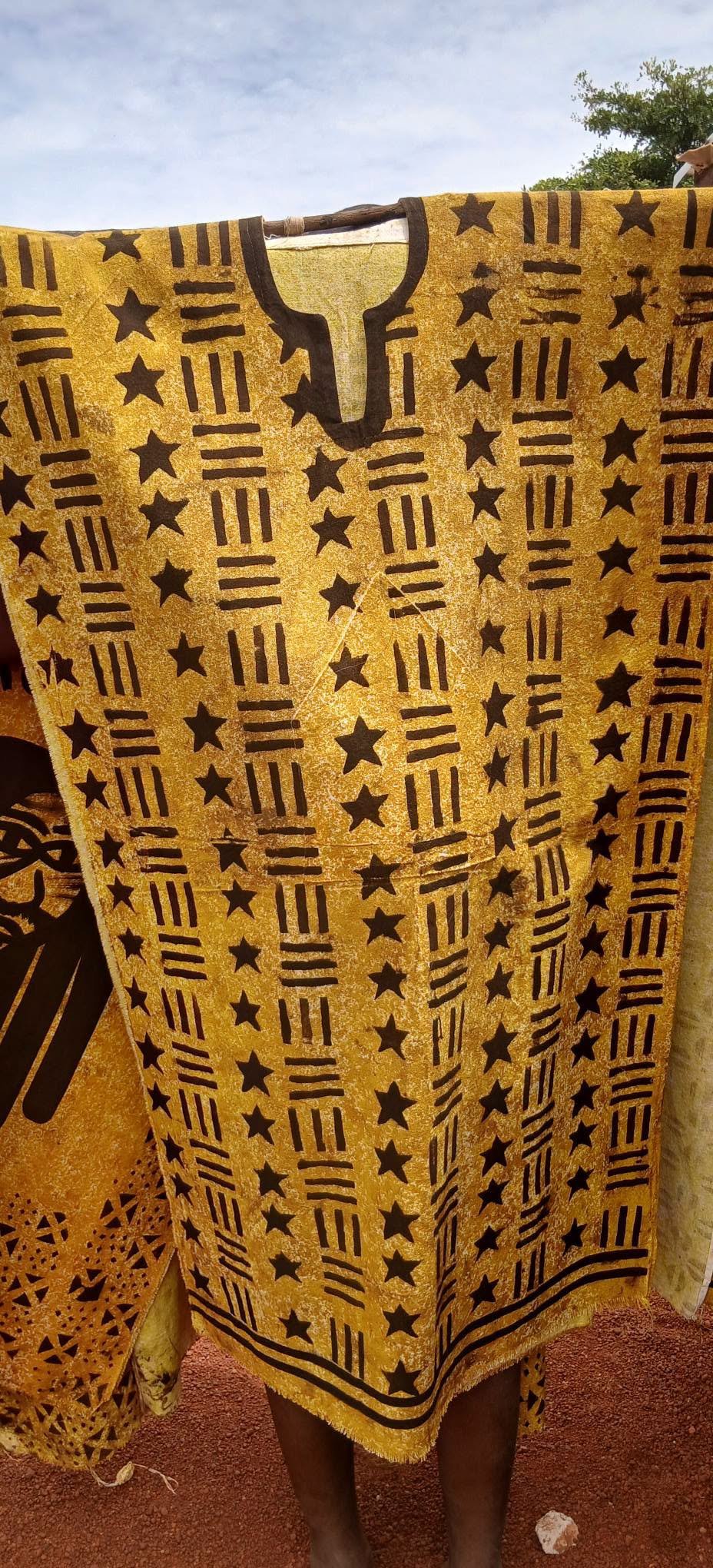
Korhogo tunic with a dense pattern of stars and strokes
TS003 Tenue senoufo
Korhogo cloth with stars
An all-over pattern with no central figure — quieter than the motif cloths.
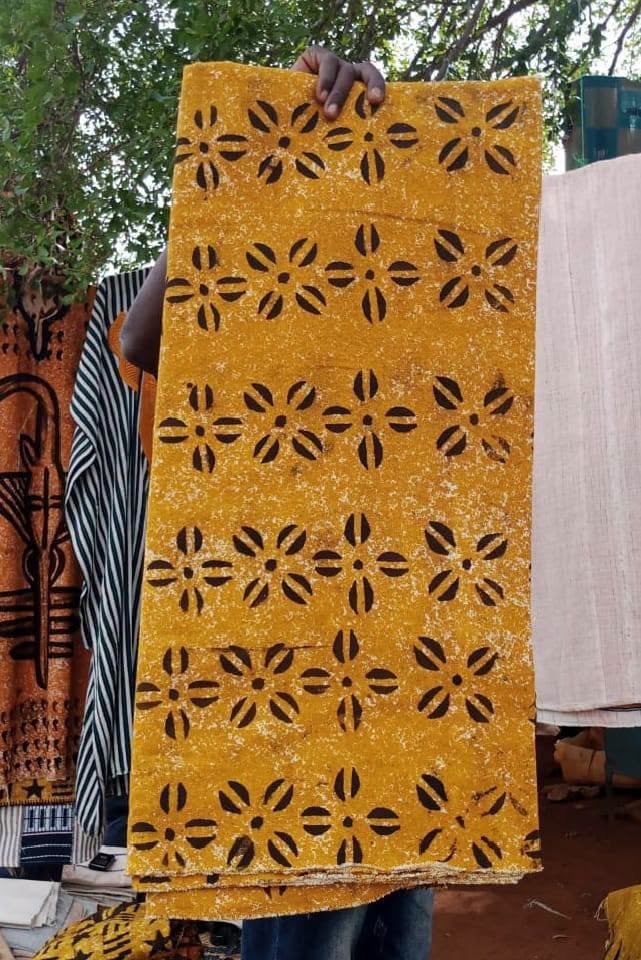
Yellow Korhogo cloth with dark floral motifs, held up
TS004 Tenue senoufo
Korhogo cloth, floral pattern
A regular run of blossoms. Held in the hand, the way it is shown at the market.
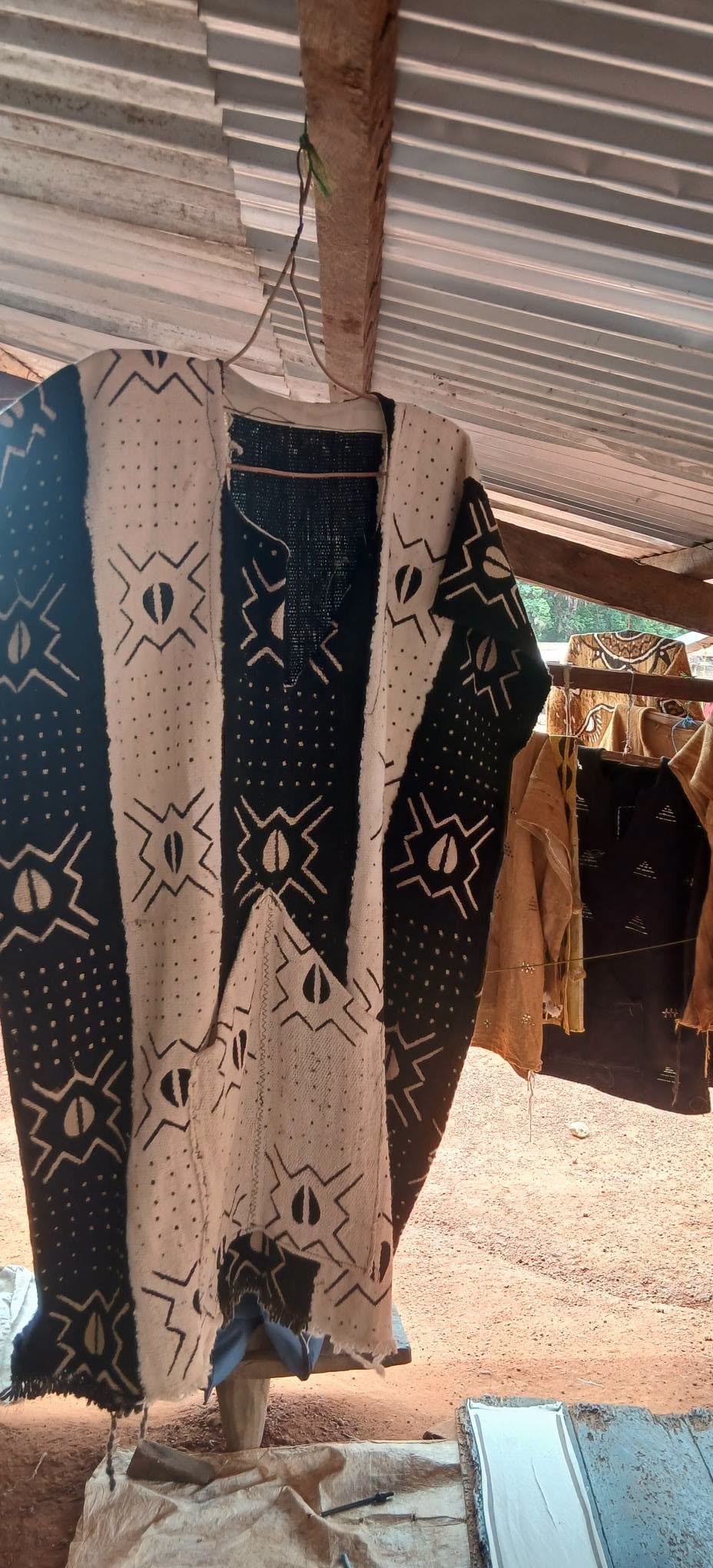
Long bogolan boubou in black and natural white with cowrie motifs
BO001 Boubou
Bogolan boubou, black and natural white
Wide cut, floor length. Motifs applied by hand, fringed hem.
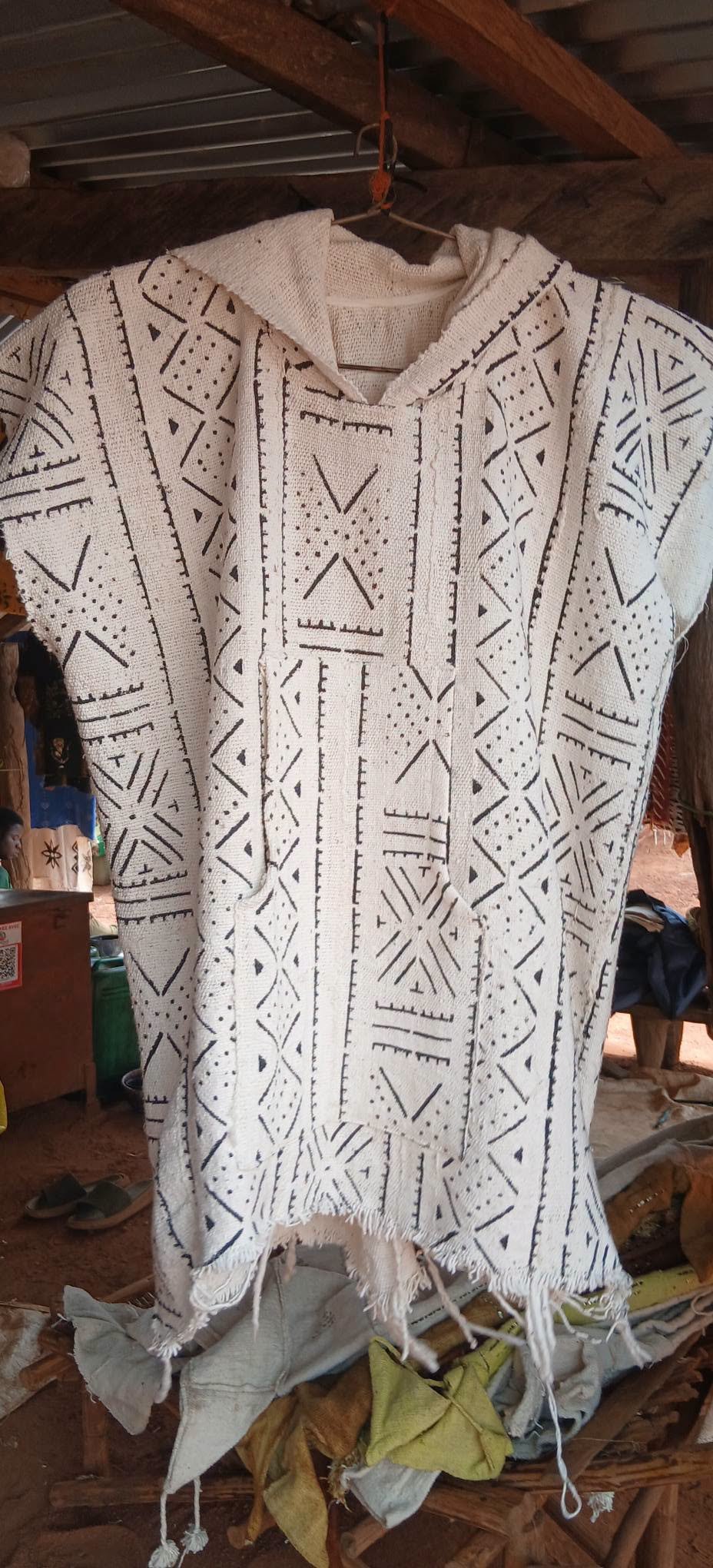
Natural white bogolan boubou with hood and dark stroke patterns
BO002 Boubou
Bogolan boubou with hood
Hooded, with dense stroke patterning over the whole surface.
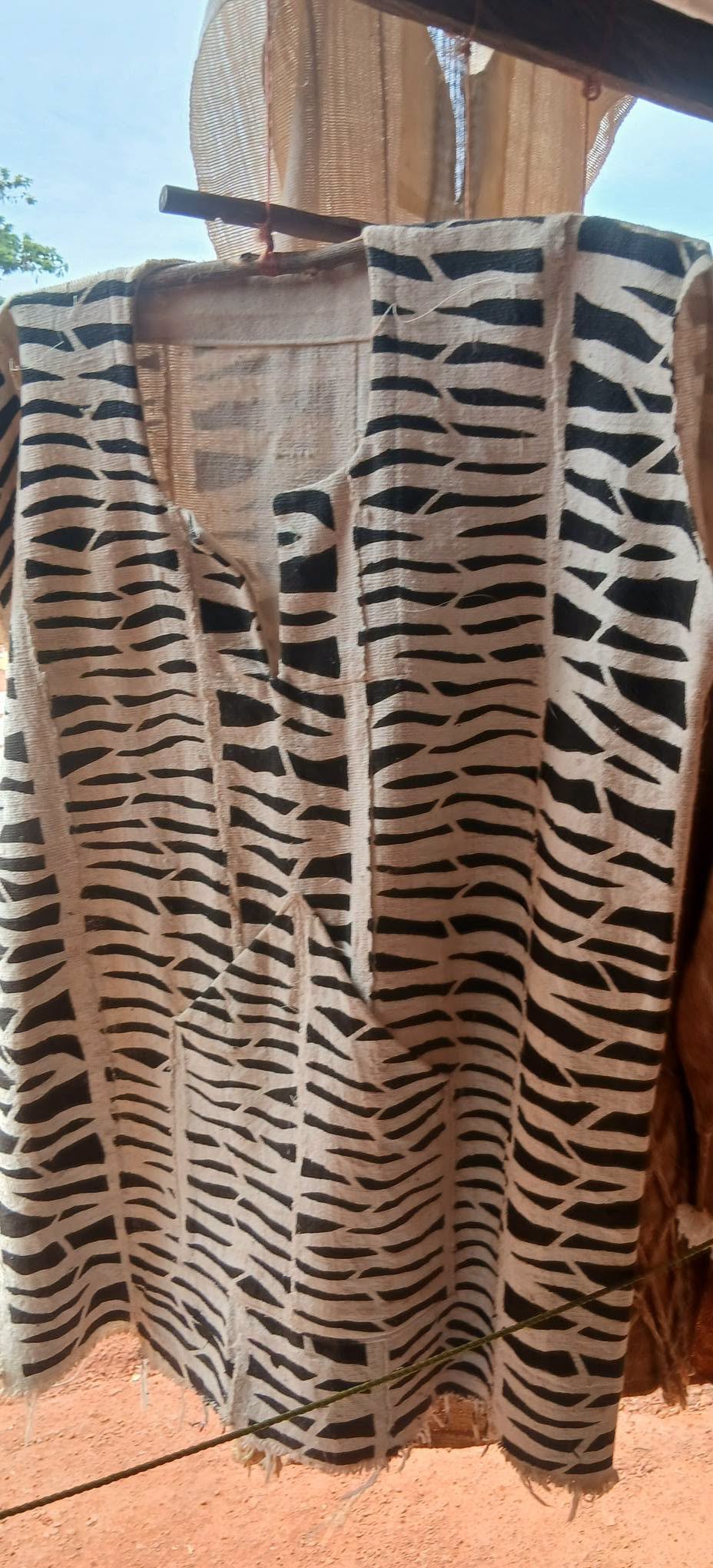
Bogolan tunic with broad black stripes on a natural white ground
BO003 Boubou
Bogolan tunic, broad stripes
Broad black stripes on a natural white ground. A shorter cut, lighter than the long boubou.
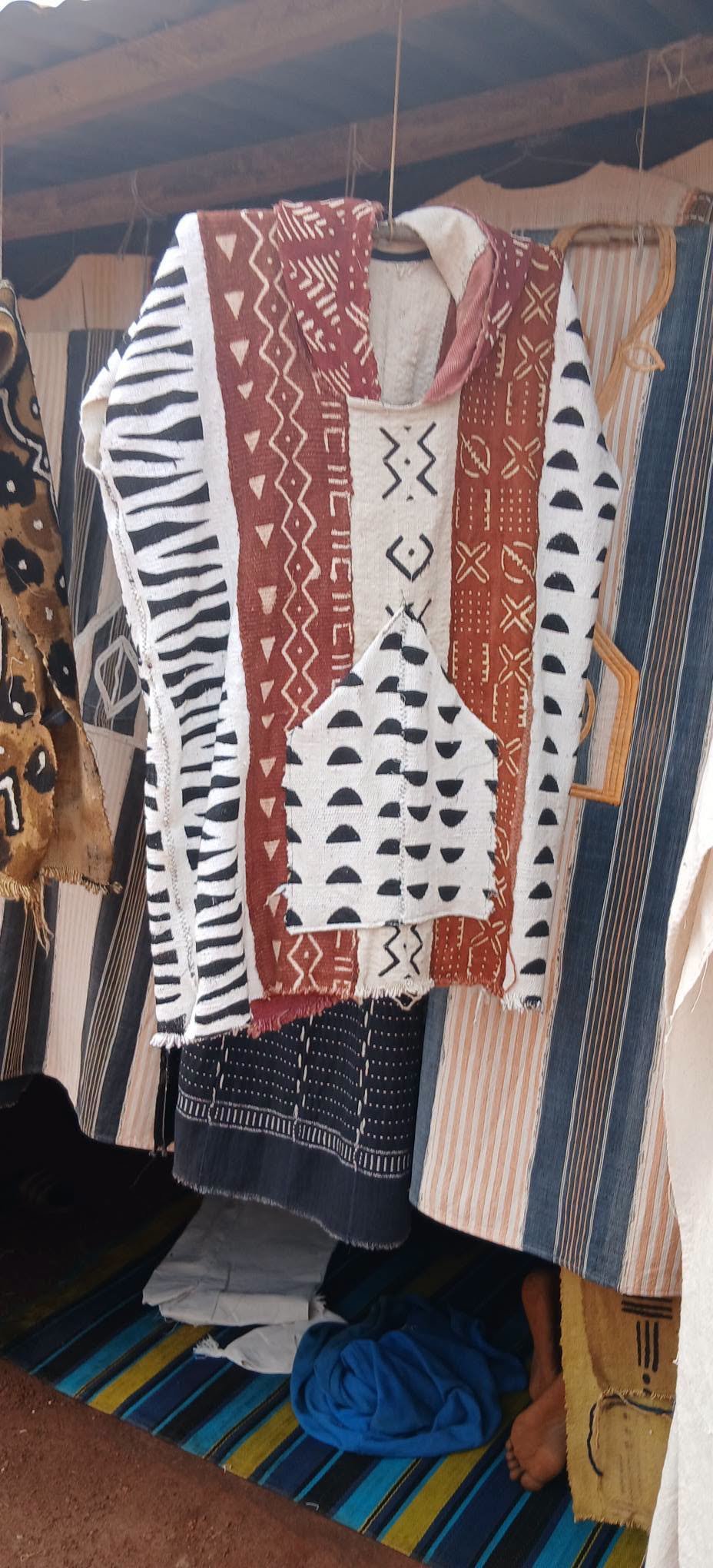
Bogolan top assembled from several patterned lengths of cloth
BO004 Boubou
Bogolan, patchwork
Assembled from several lengths — each with its own pattern.
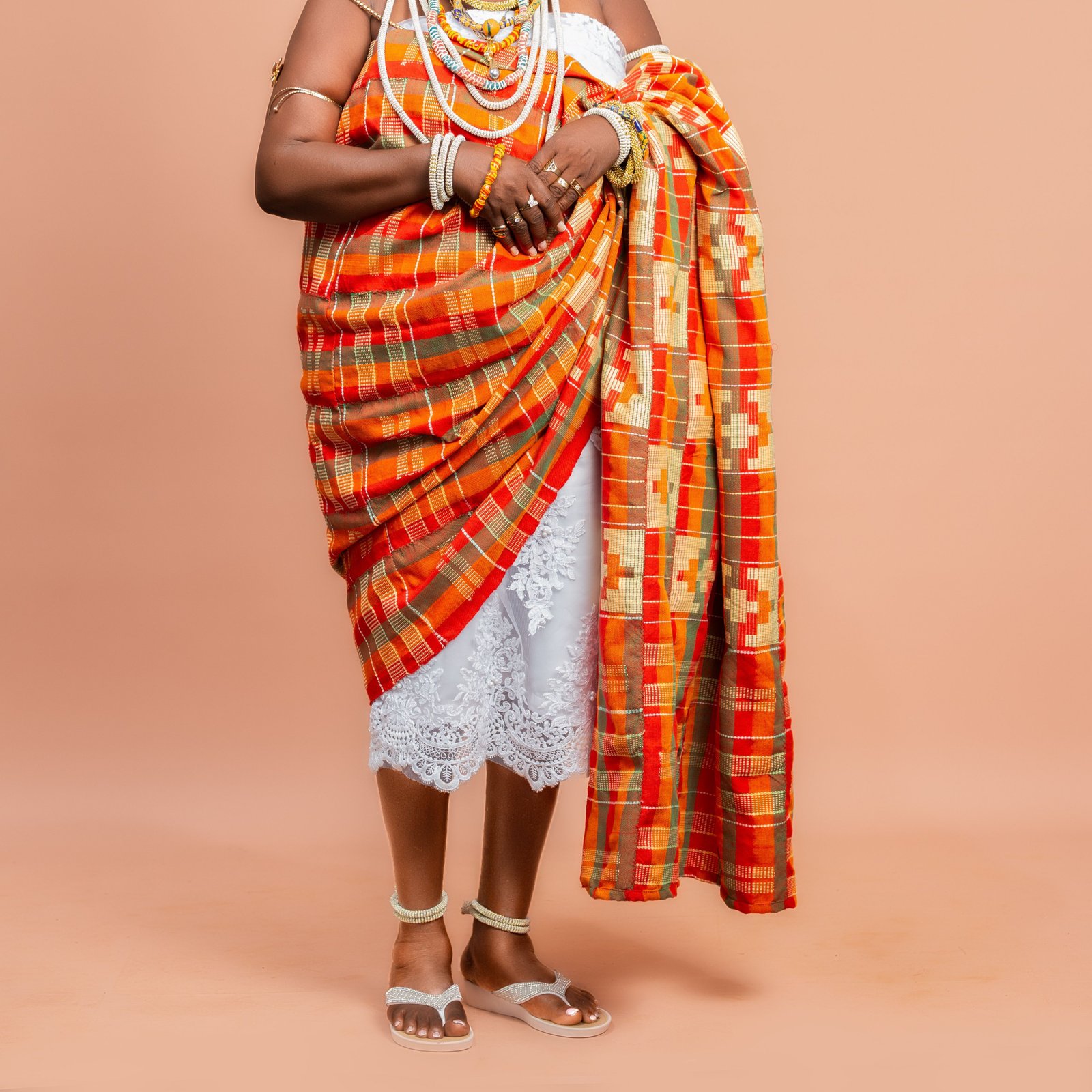
Ceremonial Akan dress worn gathered, with cowrie ornament
TA001 Tenue akan
Ceremonial dress, gathered
The cloth is gathered and tied over the shoulder, not cut and sewn.
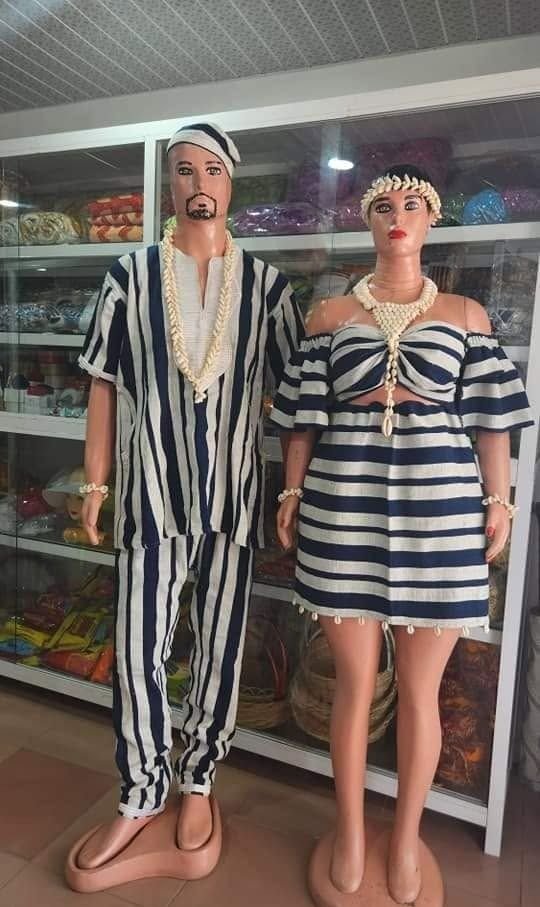
Navy ceremonial dress with extensive cowrie shell ornament
TA002 Tenue akan
Ceremonial dress with cowrie ornament
Cowrie shells at the neck, belt, arms and ankles. Shown on a display figure.
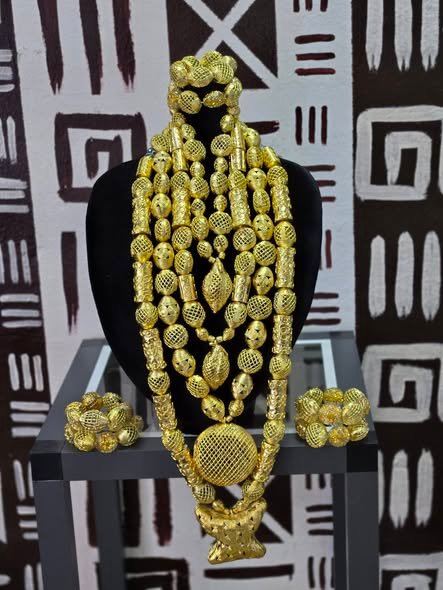
Multi-strand necklace of gold-coloured beads with a large pendant and matching bracelets
TA003 Tenue akan
Beaded necklace with pendant
A multi-strand necklace of gold-coloured beads, with bracelets as a set. Part of festive dress.
Blouse in kente cloth with geometric patterns in yellow, red, blue and green, worn with a necklace of large amber beads
TA004 Tenue akan
Kente blouse with amber beads
Blouse cut from kente cloth with woven geometric blocks, worn with a necklace and earrings of large amber-coloured beads.
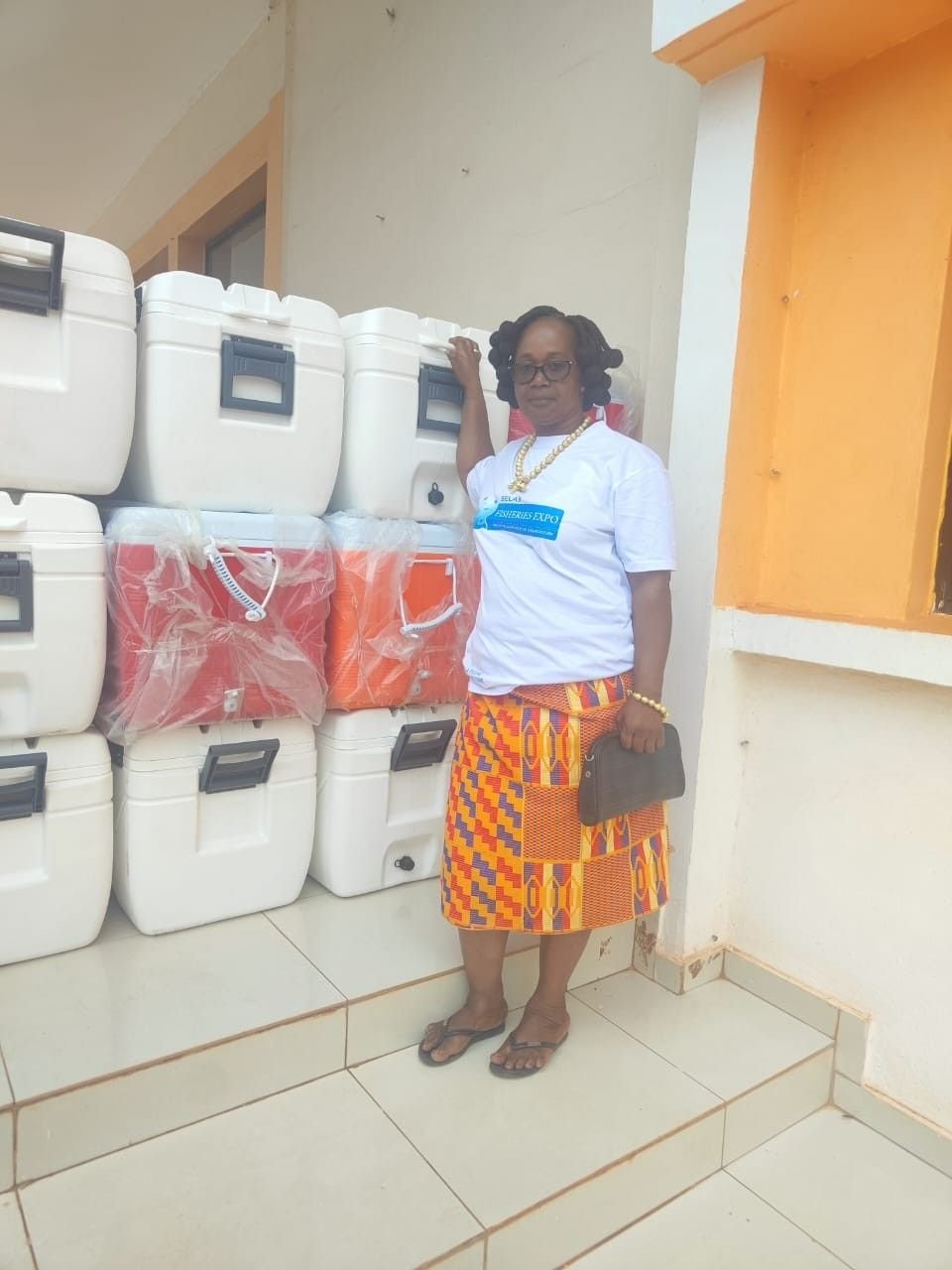
Wrap skirt in kente cloth with diamond patterns in orange, yellow and purple, worn with a white top
TA005 Tenue akan
Kente wrap skirt
Calf-length wrap skirt in kente with diamond borders. Worn with a plain top for everyday use.
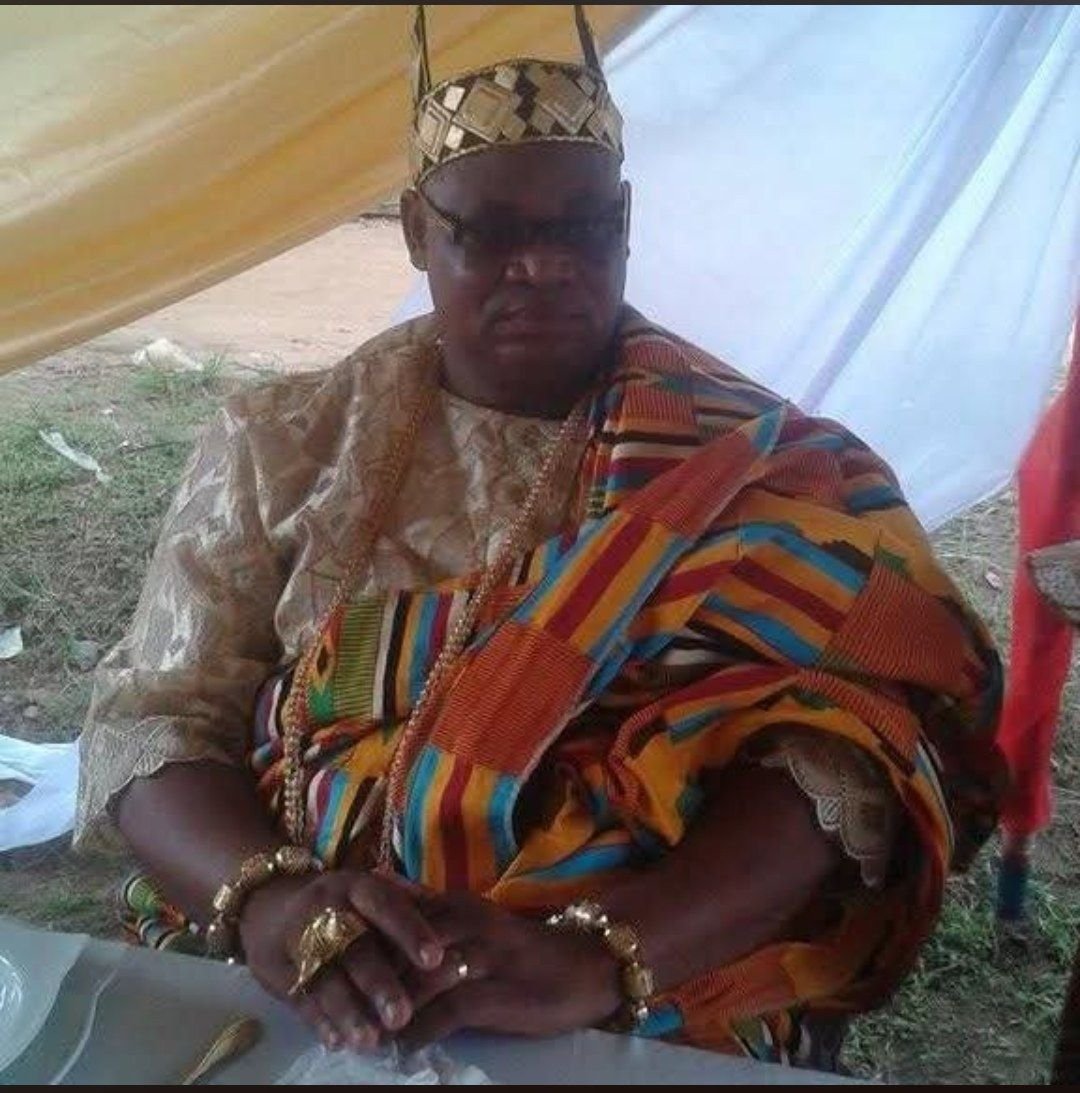
Man in Akan ceremonial dress: kente cloth over the shoulder, embroidered crown, gold jewellery on hands and wrists
TA006 Tenue akan
Ceremonial dress with kente and gold
Kente cloth worn over the shoulder above an embroidered robe, with a crown, rings, bracelets and bead necklaces — the formal dress for ceremonies.
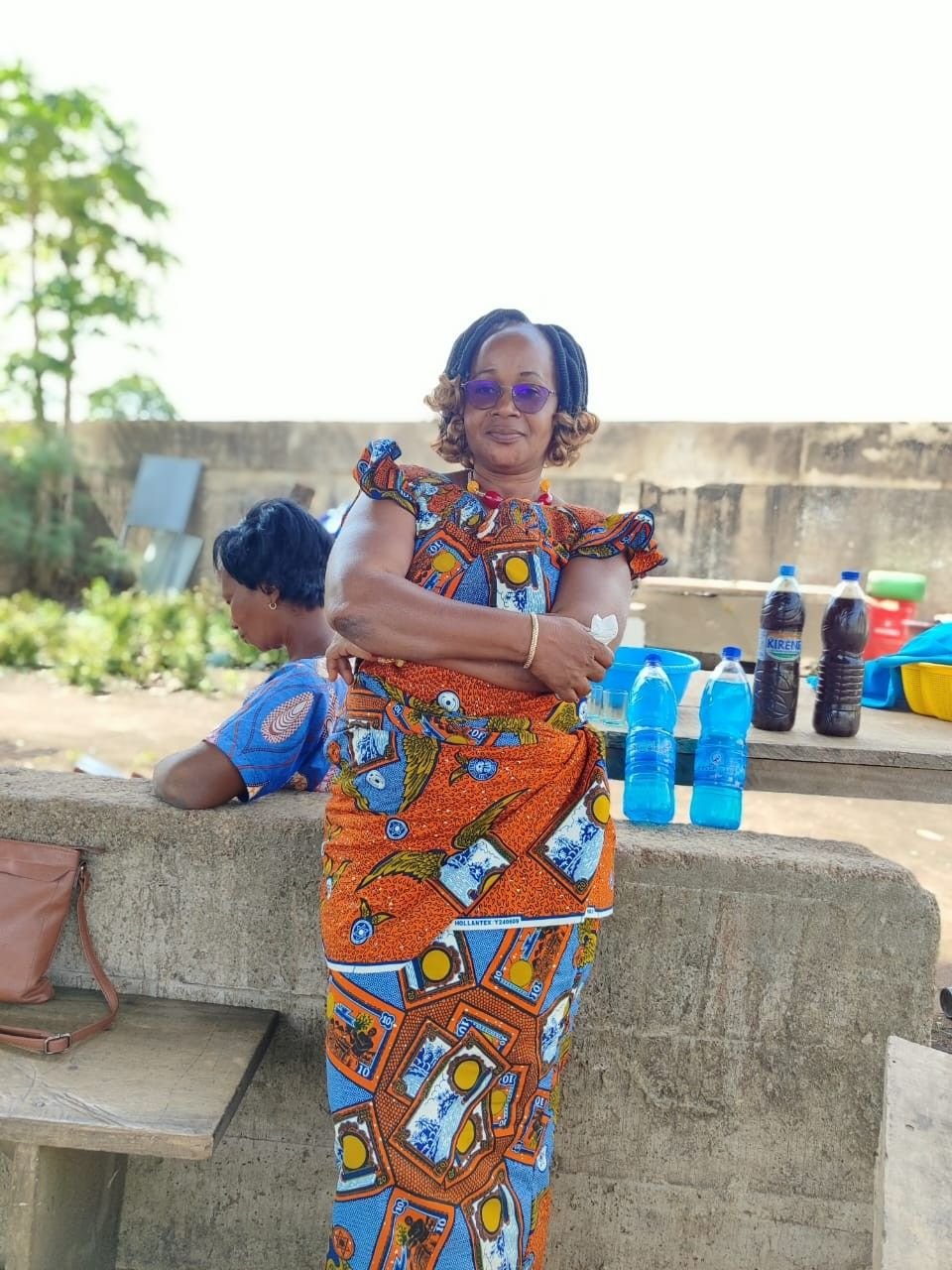
Wrapped wax pagne in orange and blue with bird and medallion motifs, worn with a top in the same cloth
WX001 Wax pagne
Wrapped wax pagne
A wrapped pagne with a matching top cut from the same wax cloth — the standard everyday combination.

Looking for a particular piece?

If you are looking for an outfit, a pagne or a particular model, write to us. We can answer questions and help you search for it in Ivory Coast — simply quote a reference from this catalogue, say PB001, describe what you are after, or send a photo. We do not sell clothing: there are no prices and no orders here, only information.

Get in touch
More about the country

More about the country

{{ l.t }} →
{{ l.b }}

The workshops are inland.

Waraniéné, Fakaha, Katiola, Bouaké — 350 to 600 kilometres from Abidjan, and there you buy from the weaver rather than the middleman. We plan the route with you and tell you what is realistic in a day.

Zum Anfrageformular

Frequently asked questions

What is pagne baoulé?

A handwoven cotton cloth from the Baoulé region around Bouaké and Yamoussoukro. It is made in narrow strips about ten centimetres wide on a hand loom, which are then sewn together into one cloth. The lengthwise seams are visible and are the mark of handwork.

Is Korhogo cloth woven or painted?

Painted. The base is a coarse handwoven cotton cloth onto which Senufo painters apply animals, masks, dancers and hunting scenes using fermented plant mud and earth pigments. This is the point most visitors get wrong.

What is the difference between kita and kente?

Kita is the ceremonial cloth of the Akan peoples in south-eastern Ivory Coast and is closely related to Ghanaian kente. Both are built from narrow woven strips; kita is generally denser, heavier and more colourful, and is worn draped at weddings, funerals and royal festivals.

Where can I buy traditional fabric in Ivory Coast?

Best at the source: Waraniéné near Korhogo for woven cloth, Fakaha for painted Korhogo cloth, Bouaké and Katiola for regional weaving. In Abidjan, Cocody and the markets of Treichville and Adjamé offer more choice but more variable quality.

How do I tell handwoven cloth from mill cloth?

Look for lengthwise seams — handwoven pagne is assembled from narrow strips, so the seams are always there. On painted cloths, check the outlines: painted by hand they are irregular, screen-printed they are identical.

Is wax fabric traditional?

Not in the strict sense — printed wax cloth arrived through European trade. It is nonetheless the everyday cloth of Ivory Coast today and the basis of Ivorian tailoring. Six metres is the usual unit, called a pagne.

Can I take textiles home from Ivory Coast?

Yes, textiles are unproblematic at customs. Souvenirs made of ivory, animal skins or protected woods are a different matter and are confiscated at European customs.

Do you sell traditional clothing?

No. This is a reference catalogue, not a shop: no prices, no basket, no ordering. If you are looking for a particular piece, quote its catalogue reference when you write to us and we will help you search for it in Ivory Coast.

What we arrange for you

Carried out by local partner companies · Car rental, driver and transfer: pay on site, no deposit
Car rental from €35 / day
City car to 4x4, with or without a driver.
Find out more →
Driver only €60 / day
A driver for your own car, 8 am to 9 pm. With a rental car, €30 extra.
Find out more →
Airport transfer from €55
Airport ↔ hotel in Abidjan, met with a name sign.
Find out more →
Local support on request
Choosing a district, having accommodation checked, practical help.
Find out more →