Nouchi: the street language of Abidjan, explained.
Nouchi started in the 1970s among young people in Abidjan and has become something closer to a language than a slang: French grammar carrying vocabulary from Dioula, Baoulé, Bété, English and pure invention. It is what you hear in the street, in music, in advertising and increasingly in politics. Knowing twenty words will not make you fluent, but it will change how people respond to you.
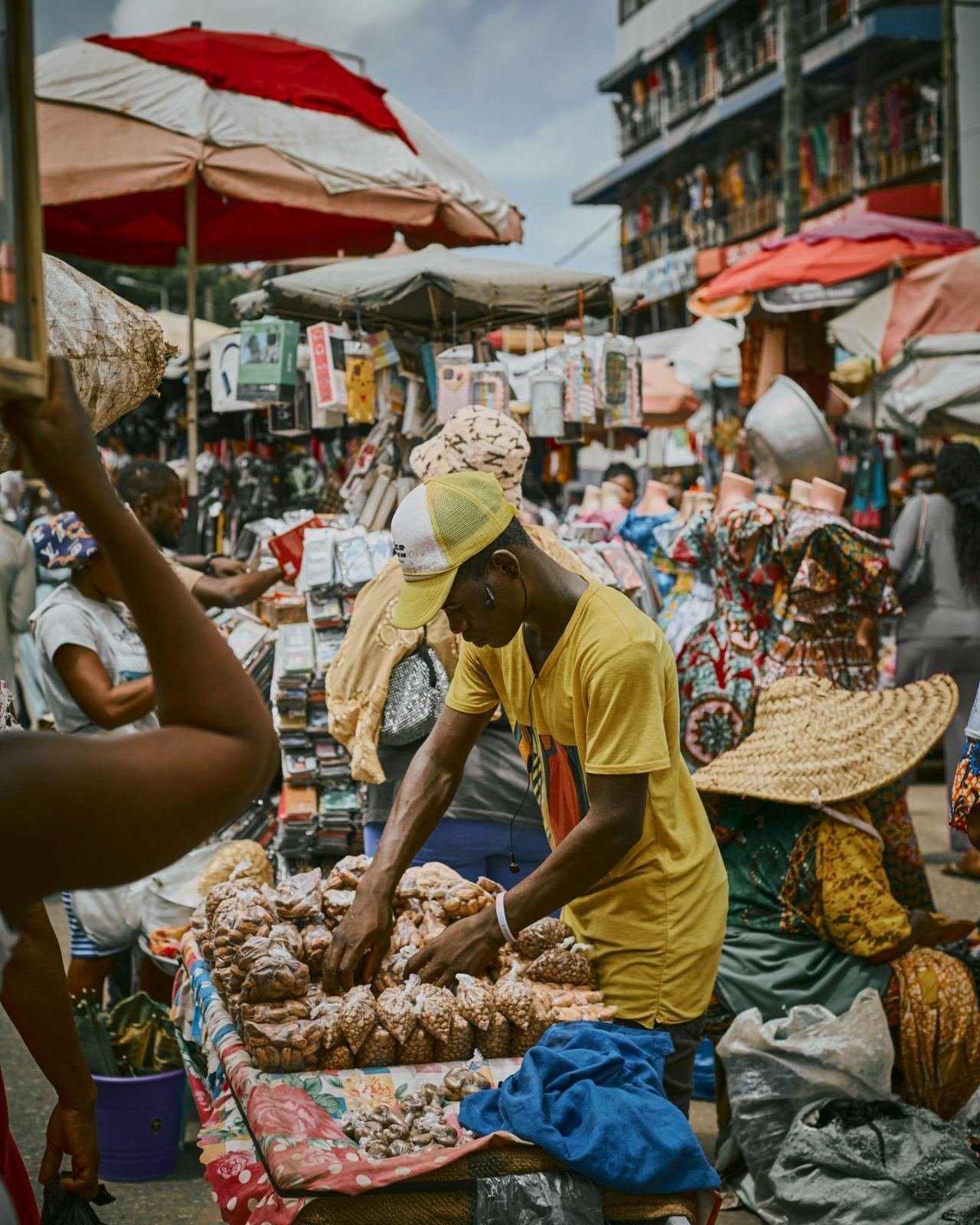 Street market, Abidjan
Words you will actually hear
{{ s.t }}
{{ c.title }}
{{ p }}
Questions we get asked
{{ f.q }}
100 words of Nouchi and everyday Abidjan speech
The words you hear in the street, at the maquis, on the gbaka and in songs. Some come from Dioula, others from French or English given a new meaning; some name dishes and drinks everyone in Abidjan knows. Nouchi moves fast: a word that is in fashion today can sound dated within a few years.
People
- Mousso
- woman, wife (from Dioula)
- Tonton
- any older man, addressed with respect
- Tantie
- older woman, often the stallholder you call to
- Vieux père
- respected man, the boss, the elder
- Petit
- a younger person you call over
- Grotto
- rich, influential person
- Grand-quelqu’un
- a big name, an important person
- Zango
- very well-dressed person
- Gnata
- someone out of touch, uncool
- Ambianceur
- the one who gets the party going
- Côcô
- freeloader, scrounger
- Faux-type
- two-faced person
- Laga-laga
- simpleton
- Vogo
- drifter
- Ziguéhi
- street tough guy
- Atalaku
- hype man who shouts out names in coupé-décalé
- Awoulaba
- curvy woman, a beauty ideal
- Chaipo
- crazy
- Maquisard
- maquis regular
- Zouglouman
- zouglou singer
Money and work
- Wari
- money (from Dioula)
- Djê
- money
- Togo
- 100 CFA francs
- Un bâton
- one million CFA francs
- Bara
- work, a job (from Dioula)
- Unité
- phone credit
- Cabine
- small stand selling credit and calls
- Couper
- to squeeze money out of someone
- C’est cadeau
- it’s free, thrown in
Vibe and style
- Enjaillement
- the buzz, the fun of a party
- Décaler
- to leave, head off
- Faroter
- to show off
- Gâter le coin
- to cause a stir, be brilliant
- C’est zo
- it’s nice, it’s great
- C’est choco
- it’s classy
- C’est djinzin
- things are heating up
- C’est tchôr
- clean, spotless
- Waha
- loads, a lot
- Zouglou
- music born in Abidjan’s student halls in the early 1990s
- Coupé-décalé
- party music of the 2000s
- Pagne
- length of cloth, the base of an outfit
- Premier gaou
- Magic System hit (1999) that made the word gaou famous
Situations and phrases
- Y a formulaire
- no problem
- Cra-cra
- tough, complicated
- Façon
- weird, not right
- Dibi-dibi
- shady
- Gnaga
- a fight, a big row
- Gnagami
- trouble, a mess
- Baga-baga
- to scare
- Mourouti
- to get angry
- Chicotter
- to punish, to hit
- Taper poto
- to fail, get turned down
- Kaba
- prison
- Zoguoh
- informer
- Lancer pierre
- to leave
- Beou
- to go away
- Foum
- gone in a flash, far off
- Daba
- to hit; also to eat heartily
- Ça va aller
- it’ll be fine
- C’est comment ?
- how’s it going, what’s up
- Y a rien
- no worries
- Laisse ça
- forget it
- Sabari
- sorry, easy now (from Dioula)
- Pardon
- please
- On est ensemble
- we’re in this together; also a goodbye
- Tout laisse
- nothing lasts, anything can change
- Kpakpatoya
- gossip
- Djassa
- the working-class neighbourhood, the street
- Nouchi
- originally the street kid, then his language
Places and getting around
- Babi
- Abidjan
- Yop
- Yopougon
- Treich
- Treichville
- Wôrô-wôrô
- shared taxi (from “thirty” in Dioula)
- Gbaka
- minibus
- Apprenti
- the lad who takes fares and shouts the gbaka’s route
- Taxi compteur
- metered private taxi
- Bateau-bus
- lagoon water bus
- Pinasse
- motorised passenger boat
Food and drink
- Maquis
- open-air eatery
- Garba
- attiéké with fried tuna
- Garbadrome
- garba joint
- Allocodrome
- grill-and-alloco spot
- Choukouya
- grilled mutton
- Attiéké
- fermented cassava couscous
- Alloco
- fried plantain
- Placali
- cassava paste
- Foutou
- pounded plantain or yam
- Kabato
- maize paste
- Kédjénou
- slow-cooked sealed stew
- Sauce graine
- palm-nut sauce
- Sauce claire
- light sauce, often with fish
- Tchêp
- rice cooked in a rich sauce
- Claclo
- plantain fritters
- Gbofloto
- dough fritters
- Dêguê
- millet and curd dessert
- Tchapalo
- millet or sorghum beer
- Bandji
- palm wine
- Koutoukou
- distilled palm spirit
- Gnamakoudji
- ginger juice
- Bissap
- hibiscus drink
The conversation starts before the destination.
Our drivers are from here. A day in the car is the fastest Nouchi lesson you will get.